

Skillset Squad · · 2 min read
A CRM usually begins with a simple requirement: record enquiries and remember to follow up.
That is useful, but it represents only one part of the customer relationship.
In a coworking business, the relationship can continue through a site visit, proposal, agreement, member onboarding, seat allocation, billing and day-to-day support.
A lead may belong to an organization. The organization may have several members. Each member may use a specific space. The subscription may change while the relationship continues.
These details matter because a real operating system must represent the business, not merely store contact information.
Begin With Entities, Not Screens
Before designing the interface, define what the business needs to understand.
An organization and a member are not interchangeable records.
A membership is not the same as an invoice. A cabin is not the same as an individual seat. A tour is not the same as an active subscription.
These distinctions influence what information the system can retrieve and what employees can do.
Map the Journey
A useful starting point is:
- 01Enquiry
- 02Qualification
- 03Tour
- 04Proposal
- 05Subscription
- 06Onboarding
- 07Support
- 08Renewal
Every transition needs a clear trigger and owner.
For example, when does a prospect become a member? What happens when the organization adds another employee? Who confirms the seat allocation? Where is a changed commercial term recorded?
The answers should exist before implementing automation.
Decide Where the Truth Lives
Businesses often use separate platforms for communication, CRM, billing and accounting.
An integration must define which system is authoritative for each type of information.
Duplicating records without clear ownership creates reconciliation problems.
Build for Exceptions
A member may change seats. A company may expand. A payment may be delayed. A booking may be cancelled.
These are ordinary operating realities, not unusual edge cases.
The CRM should support them in a controlled way.
Takeaway
The most useful CRM design often starts with observing the business.
Better data models emerge from understanding real relationships, decisions and exceptions—not from adding more fields to a lead form.
Context and evidence
Work246 provides the operating context for this discussion. The data model and integration examples are illustrative requirements; they do not establish that every described module is deployed.
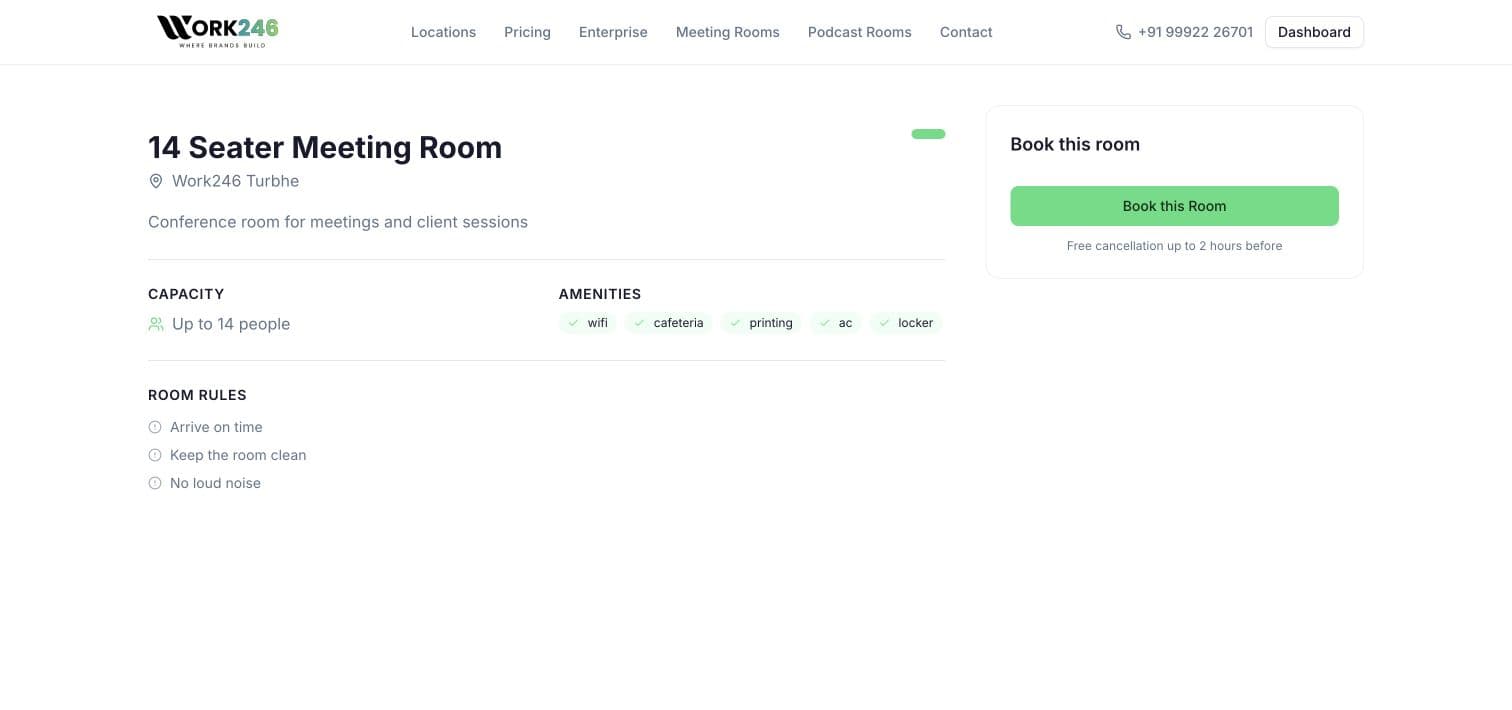
A real shared-facility listing
Public Turbhe room listing captured on 11 October 2026. The listing and booking entry point are observable; occupancy, member records, billing, attendance and integrations were not internally verified.
View the public source